
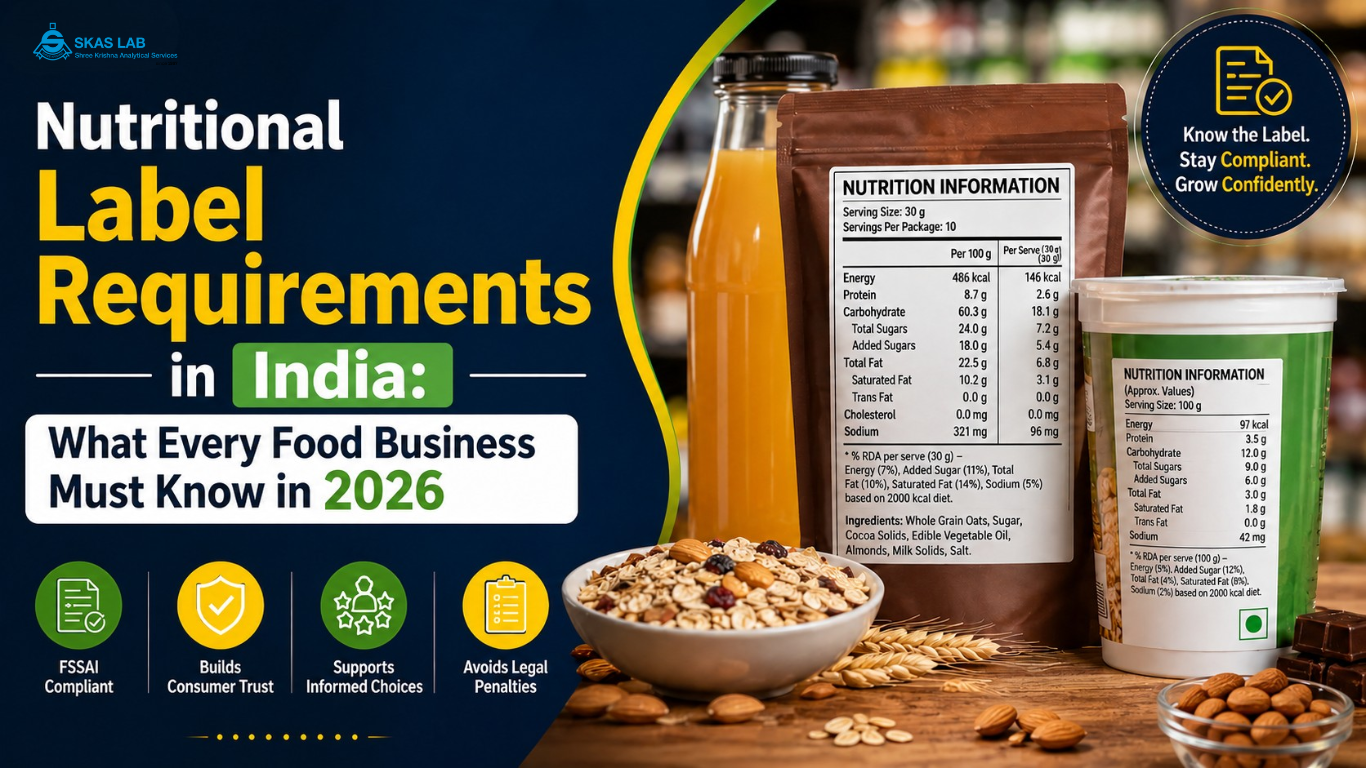
Nutritional Label Requirements in India: What Every Food Business Must Know in 2026
Walk into any supermarket in India and pick up a packet of biscuits, a tetra-pack of juice, or a bag of breakfast cereal. Somewhere on that package is a small panel of numbers and text — calories, carbohydrates, protein, fats. That panel is not optional decoration. It is a legal requirement. India's food labelling framework has evolved significantly over the last decade, with the Food Safety and Standards Authority of India (FSSAI) steadily tightening the rules around what food businesses must declare, how they must declare it, and what happens when they don't.
For food manufacturers, exporters, and private label brands, getting nutrition labelling right is no longer just a compliance checkbox. It is a business necessity — one that affects retail approvals, export clearances, and consumer trust. This guide breaks down the current nutritional label requirements in India, explains the relevant FSSAI regulations, and gives you a practical framework for staying compliant in 2026.
The Regulatory Framework: Where Do These Rules Come From?
India's food labelling requirements are primarily governed by:
1. Food Safety and Standards (Labelling and Display) Regulations, 2020 — This regulation replaced the older FSS (Packaging and Labelling) Regulations, 2011 and brought India's labelling framework closer to global standards. It is the primary legal document that defines what must appear on every packaged food product sold in India.
2. Food Safety and Standards (Advertisement and Claims) Regulations, 2018 — Governs what claims (nutritional, health, or comparative) can and cannot appear on packaging.
3. Food Safety and Standards Act, 2006 — The parent legislation that empowers FSSAI to set and enforce all food safety and labelling standards.
4. Codex Alimentarius Commission Guidelines — FSSAI regulations are largely aligned with Codex Alimentarius international food standards, the global reference for food safety and labelling developed jointly by the FAO and WHO.
Understanding this framework is the starting point for any food business operating in India. For businesses that also export, additional country-specific labelling regulations from the destination market apply alongside Indian requirements.
What Is a Nutrition Facts Label and Why Is It Mandatory?
A nutrition facts label — also called a nutrition declaration under FSSAI regulations — is a structured panel on packaged food that tells the consumer:
- What energy (calories) the product provides
- How much protein, carbohydrate, fat, and other nutrients it contains
- What serving size the values are calculated on
Under the Food Safety and Standards (Labelling and Display) Regulations, 2020, a nutrition declaration is mandatory for all packaged food products sold in India, with very limited exceptions for small producers and certain unprocessed commodity categories.
This isn't just an Indian rule. Almost every major food regulatory authority in the world — the US FDA, European Food Safety Authority, UK FSA, and Australia's FSANZ — requires some version of a nutrition label. FSSAI's current framework is broadly aligned with these global standards, making compliance easier for exporters and importers operating in multiple markets.
Mandatory Information on a Nutritional Label in India (FSSAI 2020 Regulations)
This is the core of what food manufacturers need to get right. Under the 2020 regulations, every nutrition declaration on an Indian food label must include the following, expressed per 100g or 100ml of the product, AND per serving (if the serving size is declared):
The Core Mandatory Nutrients
| Nutrient | Unit | Required? |
|---|---|---|
| Energy | kcal | ✔ Mandatory |
| Total Protein | g | ✔ Mandatory |
| Total Carbohydrate | g | ✔ Mandatory |
| — of which Sugars | g | ✔ Mandatory |
| Total Fat | g | ✔ Mandatory |
| — of which Saturated Fat | g | ✔ Mandatory |
| — of which Trans Fat | g | ✔ Mandatory |
| Sodium | mg | ✔ Mandatory |
What Is Not Mandatory but May Be Declared Voluntarily
- Total dietary fibre
- Cholesterol
- Vitamins and minerals (unless a claim is made)
- Polyunsaturated and monounsaturated fats
- Starch and sugar alcohols
Important: If a claim is made about any nutrient — "high in protein," "low in sugar," "good source of calcium" — then that nutrient must be declared on the nutrition panel, even if it would otherwise be optional.
Labelling Format and Presentation Rules
Getting the right numbers is only half the job. FSSAI also specifies how the nutrition declaration must be presented on the pack.
1. Per 100g / 100ml Declaration (Mandatory)
All values must be expressed per 100g or 100ml of the food as sold. This allows consumers to make a fair comparison across different products and brand sizes.
2. Per Serving Declaration (If Serving Size Is Mentioned)
If the label includes a "serving size" or "per serving" statement, the nutrition values must also be provided per serving alongside the per 100g/ml figures.
3. Tabular or Linear Format
FSSAI allows both tabular (two-column table) and linear (running text) format for the nutrition declaration. Tabular is standard and strongly preferred from a readability standpoint.
4. Minimum Font Size
The text in the nutrition panel must be legible. FSSAI prescribes minimum font sizes — generally 1mm height for most text — but legibility and contrast are also evaluated during enforcement.
5. Placement
The nutrition declaration must appear on the label of the package in a prominent location. For pre-packaged products, it is usually placed on the back or side panel.
Other Mandatory Label Declarations (Beyond Nutrition)
While this guide focuses on nutrition labelling, it is worth noting that FSSAI's labelling regulations cover several other mandatory declarations that must appear alongside the nutrition panel:
- Product name and nature of the food
- Net weight or volume (in metric units)
- List of ingredients (in descending order of weight)
- Allergen declaration (highlighted in bold, italics, or underlined within the ingredient list)
- Name and address of the manufacturer, packer, or importer
- FSSAI license number of the manufacturer
- Batch/lot number
- Date of manufacture and best before/use by date
- Country of origin (for imported food)
- Storage instructions where applicable
Missing or incorrect information on any of these elements can result in product rejection, penalties, or a recall under the Food Safety and Standards Act.
Traffic Light Labelling and Front-of-Pack Declarations
One of the most discussed updates in recent years has been FSSAI's proposal for Front-of-Pack Nutrition Labelling (FOPL). After years of consultation and debate, FSSAI has proposed an approach under which processed food products above specified thresholds for energy, saturated fat, trans fat, added sugar, and sodium would carry a prominent front-of-pack warning label.
As of 2026, the final FOPL regulations are in an advanced stage. Food businesses — particularly those producing processed snacks, beverages, instant food, and confectionery — should monitor FSSAI's official portal for labelling regulation updates closely and begin internal impact assessments now.
This is especially important for brands that sell through major retail chains, which may independently require front-of-pack declarations even before the regulation becomes mandatory.
Common Labelling Mistakes That Lead to Non-Compliance
Even well-intentioned food businesses make errors in nutrition labelling. Here are the most common pitfalls:
1. Wrong reference quantity — Expressing nutritional values per serving size only without the mandatory per 100g/ml declaration is a frequent compliance gap.
2. Incorrect energy calculation — Energy (kcal) must be calculated using the standard conversion factors: protein × 4, carbohydrate × 4, fat × 9, alcohol × 7. Errors in these calculations are common when labelling is done without laboratory analysis.
3. Trans fat not declared — Many manufacturers mistakenly omit trans fat, especially for products that use partially hydrogenated oils or interesterified fats.
4. Allergen information missing or unclear — Allergens must be specifically highlighted, not just listed within the ingredient declaration in the same font and format as other ingredients.
5. Voluntarily declared nutrients with no backing data — If a brand chooses to declare fibre, cholesterol, or vitamins, the values must be supported by actual laboratory analysis, not estimated or copied from generic databases.
6. Outdated formulation values on label — When a product's recipe changes, even slightly, the nutrition declaration must be recalculated and updated. Using outdated figures is a compliance violation.
7. Rounding values incorrectly — FSSAI prescribes specific rounding rules. For example, energy can be rounded to the nearest whole number, while fat values below 0.5g can be declared as zero. These nuances are frequently missed.
Why Laboratory Testing Is Essential for Accurate Nutrition Labels
Nutritional values on a food label cannot be pulled from a generic ingredient database or estimated from a recipe. For regulatory compliance, they must be based on actual analytical testing of the final product.
This is because:
- Processing methods (heating, frying, fermentation) change nutrient composition
- Ingredient sourcing variations affect protein, fat, and moisture content
- Multi-ingredient products have complex interactions that generic databases cannot accurately capture
- FSSAI and export authorities may request laboratory substantiation of label values at any time
A NABL-accredited laboratory like SKAS Lab conducts comprehensive nutritional analysis covering energy, macronutrients, moisture, ash, trans fats, saturated fats, dietary fibre, sodium, and vitamins — providing test reports that meet FSSAI, BIS, and export authority requirements.
For food businesses that also export, the test report from an accredited lab is not just useful — it is often a mandatory submission document. To understand why laboratory accreditation matters so much in this context, read this detailed article on why NABL accreditation matters for food testing labs.
FSSAI Labelling Compliance: Step-by-Step for Food Manufacturers
Here is a practical checklist for manufacturers preparing to launch or review a packaged food product:
Step 1 — Get the product analysed in a NABL-accredited laboratory. Submit a representative sample of the final, finished product for nutritional analysis. Ensure the lab tests for all eight mandatory nutrients plus any voluntarily declared ones.
Step 2 — Calculate energy using FSSAI conversion factors. Use the standard values: 4 kcal/g for protein, 4 kcal/g for carbohydrates, 9 kcal/g for fat. Do not use manufacturer estimates or software defaults without cross-checking.
Step 3 — Define your serving size carefully. While per 100g/ml is mandatory, your serving size should reflect a realistic portion of your product. Use this to calculate per-serving values alongside the mandatory reference quantity.
Step 4 — Design the nutrition panel in the correct format. Use a tabular format wherever possible. Ensure font sizes meet FSSAI minimums and contrast is adequate for legibility.
Step 5 — Cross-check all mandatory label declarations. Run through the complete checklist — ingredients, allergens, FSSAI license number, batch number, best before date, manufacturer address, net weight.
Step 6 — Review claims for compliance with FSSAI claims regulations. Any nutrition or health claim on the label must comply with the Food Safety and Standards (Advertisement and Claims) Regulations, 2018. Ensure the nutrient meets the threshold required to support the claim.
Step 7 — Update labels whenever formulation changes. Build a process to trigger label review and fresh laboratory testing whenever a significant formulation change occurs.
SKAS Lab: Analytical Testing for FSSAI-Compliant Nutrition Labels
SKAS Lab (Shree Krishna Analytical Services) is a NABL-accredited testing laboratory in New Delhi offering comprehensive nutritional analysis services for food manufacturers, exporters, FMCG companies, cloud kitchens, and private label brands across India.
Our nutritional testing scope covers:
- Proximate analysis (moisture, protein, fat, carbohydrates, ash, energy)
- Total and saturated fat analysis
- Trans fatty acid profiling
- Dietary fibre (total, soluble, insoluble)
- Sodium and mineral analysis
- Vitamins (A, B-group, C, D, E)
- Sugar profiling (total sugars, added sugars, sugar alcohols)
Every report is issued under ISO/IEC 17025 accreditation and includes the NABL logo — the mark of credibility that FSSAI auditors, retail buyers, and export authorities recognise.
Whether you are a new food brand preparing your first product for launch or an established manufacturer updating labels after a reformulation, SKAS Lab provides the scientific foundation your compliance team needs.
Explore SKAS Lab's full range of food and agricultural testing services for manufacturers or visit the SKAS Lab home page to understand our accredited testing capabilities.
Real-World Scenarios: When Labelling Goes Wrong
Scenario 1 — The Export Rejection Over Trans Fat
A biscuit manufacturer in Delhi was exporting to a Gulf market. The shipment was held at customs because the nutrition label showed "0g trans fat" while the product used partially hydrogenated palm oil. Lab analysis confirmed measurable trans fat levels. The company had never had the final product tested — the "0g" had been estimated. After NABL-accredited analysis, the formulation was revised, the label was corrected, and the export was cleared on the next shipment.
Scenario 2 — The High-Protein Snack That Wasn't
A health-food startup launched a puffed snack with "High in Protein" prominently on the front of the pack. The claim was based on the protein content of one raw ingredient, not the finished product. When a third-party retailer's quality team tested the product, protein levels were significantly lower than claimed. The retailer delisted the product. The startup lost the account, relabelled after genuine lab testing, and re-approached the retailer six months later.
Scenario 3 — The Allergen Incident That Cost a Brand Its Listing
A packaged condiment brand was listed with a large modern trade chain. A consumer flagged the product for causing an allergic reaction. Investigation revealed the product contained a trace amount of peanut protein from a shared processing line — undisclosed on the label. The brand was pulled from shelves, incurred a FSSAI notice, and spent months on a corrective action programme before relisting. This case directly illustrates why allergen testing must accompany nutritional analysis, a subject covered in SKAS Lab's blog on food adulteration testing methods used by NABL laboratories.
Frequently Asked Questions
Q1. Is a nutrition declaration mandatory for all packaged food in India?
Yes. Under the Food Safety and Standards (Labelling and Display) Regulations, 2020, a nutrition declaration is mandatory for all packaged food products. Small manufacturers with a turnover below a certain threshold were granted a transitional period, but the majority of food businesses are now required to comply fully.
Q2. What nutrients must be declared on an Indian nutrition label?
The eight mandatory nutrients are: energy (kcal), total protein, total carbohydrate, total sugars, total fat, saturated fat, trans fat, and sodium. Additional nutrients can be declared voluntarily or must be declared if a nutritional claim is made.
Q3. Can I calculate nutrition values myself without laboratory testing?
No — not for regulatory compliance. FSSAI expects nutrition values to be backed by actual laboratory analysis of the finished product. Estimates based on recipe databases or ingredient specifications are not considered compliant substantiation.
Q4. What is the difference between "best before" and "use by" dates?
"Best before" indicates the period during which the food retains its expected quality under proper storage. "Use by" indicates a safety-critical deadline after which the product should not be consumed. FSSAI labelling regulations define when each must be used.
Q5. Do imported food products need FSSAI-compliant labels?
Yes. Imported packaged food must either carry a compliant label at the point of manufacture or have a sticker applied at the port of entry before distribution. The importer is responsible for compliance under FSSAI regulations.
Q6. What happens if a food product's label is found non-compliant by FSSAI?
Consequences can range from a formal notice and directed corrective action to product seizure, recall, financial penalties, and in serious cases, suspension of the FSSAI license under the Food Safety and Standards Act, 2006.
Q7. How often should I get my product retested for nutritional labelling?
Best practice is to retest whenever there is a formulation change, a change in ingredient suppliers, or a significant change in the manufacturing process. Otherwise, annual retesting for quality assurance is recommended for most product categories.
Q8. Can SKAS Lab help with nutrition testing for FSSAI label compliance?
Yes. SKAS Lab provides complete proximate and extended nutritional analysis for packaged food, with NABL-accredited reports that meet FSSAI, BIS, and export authority requirements. Reach out through the SKAS Lab contact and sample submission page to discuss your requirements.
Conclusion
Nutritional label compliance in India is no longer optional — and it is only getting more rigorous. With FSSAI strengthening enforcement, major retailers raising their supplier quality standards, and consumers paying more attention to what they eat, getting your nutrition label right is one of the most important investments a food business can make.
The process starts with accurate laboratory analysis, follows through with careful label design, and requires ongoing attention whenever formulations or ingredients change.
SKAS Lab is here to support food manufacturers, startups, and exporters with the analytical testing services needed to build FSSAI-compliant labels grounded in real data. No guesswork. No generic databases. Just accurate, accredited test results that your compliance team and your customers can rely on.
If you would like to discuss your product's nutrition testing requirements, the team at SKAS Lab is available to help — no pressure, just expert advice.
Stay updated on food safety regulations, FSSAI updates, and laboratory testing insights by following SKAS Lab on Facebook, Instagram and LinkedIn.
