
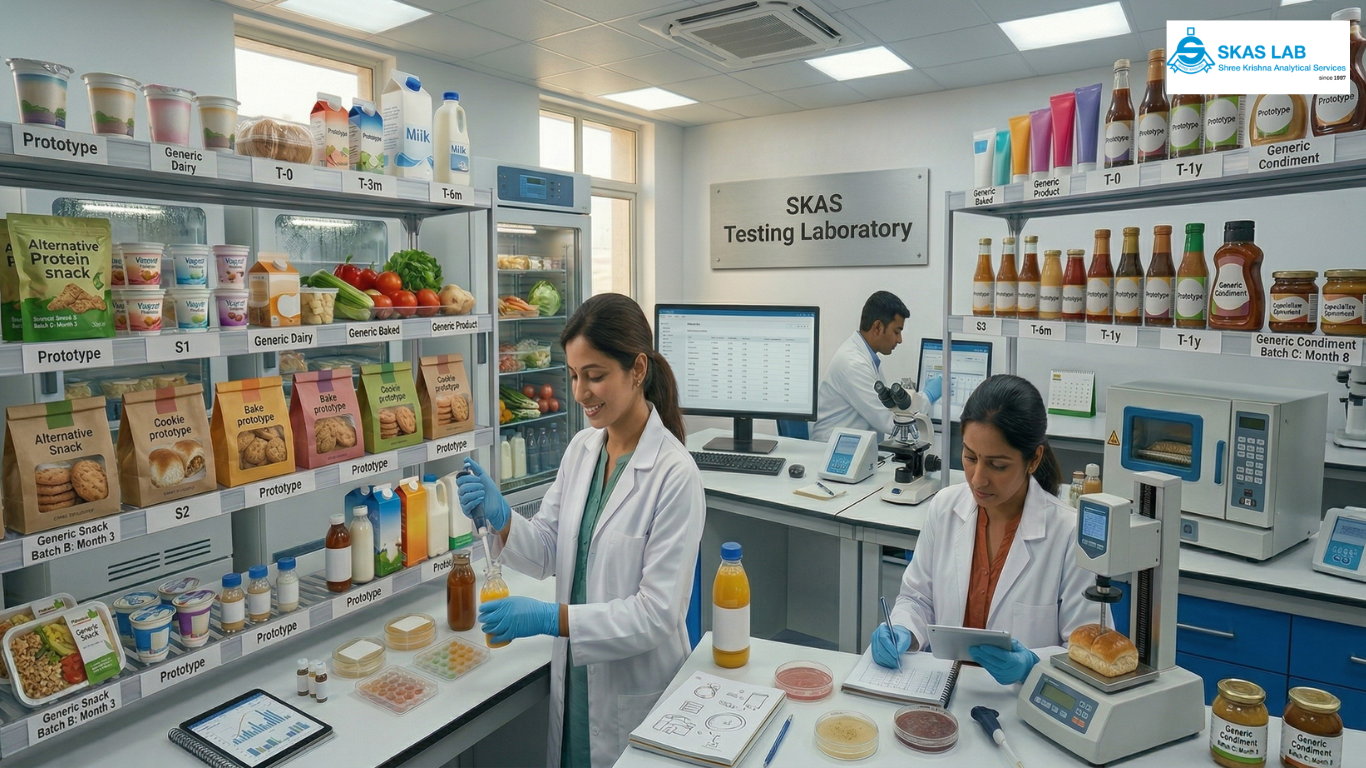
NABL vs Non-NABL Labs: Why It Matters for FSSAI Compliance
If you run a food business in India, one question can quietly make or break your regulatory standing: Is your testing lab NABL-accredited? Whether you are searching for a NABL testing laboratory in Delhi or re-evaluating your current lab partner the answer matters far more than most food business owners realize.
Most FBOs assume any lab report works for FSSAI submissions. That assumption is expensive. Every year, businesses face rejected applications, failed audits and compliance penalties not because their products were unsafe, but because their test reports came from labs FSSAI does not recognize.
This guide breaks down what NABL accreditation actually means, why FSSAI treats it as non-negotiable, and what to check before choosing a food testing lab.
1. What Is NABL Accreditation?
NABL stands for the National Accreditation Board for Testing and Calibration Laboratories. It operates under the Quality Council of India (QCI) and is the only government-authorized accreditation body for testing labs in India.
What Does NABL Accreditation Actually Confirm?
When a lab earns NABL accreditation, an independent body has verified through on-site audits, document reviews and proficiency testing that it meets ISO/IEC 17025:2017, the global standard for testing and calibration competence.
Any NABL-accredited laboratory in Delhi or elsewhere in India must demonstrate that it:
- Uses validated, internationally recognized testing methods
- Employs qualified and trained analysts
- Maintains calibrated, traceable equipment
- Produces results that hold up legally and scientifically
Why Does International Recognition Matter?
NABL is a signatory to the ILAC (International Laboratory Accreditation Cooperation) and APAC (Asia Pacific Accreditation Cooperation) mutual recognition arrangements. This means test reports from NABL-accredited laboratories are accepted in dozens of countries, a direct advantage for exporters and importers dealing with global markets.
2. How FSSAI and NABL Are Linked
The Food Safety and Standards Authority of India (FSSAI) governs food safety under the FSS Act, 2006. Under Section 43 of this Act, FSSAI recognizes and notifies food testing laboratories, and NABL accreditation is the primary qualifying requirement.
Key Regulatory Rules Every FBO Must Know
- A lab must hold NABL accreditation under ISO/IEC 17025 for both chemical and biological testing to qualify for FSSAI recognition.
- The accreditation scope must cover at least 6 food product categories under the Food Safety and Standards Regulations (FSSR).
- If a lab's NABL accreditation is suspended or withdrawn, its FSSAI recognition is also suspended immediately and automatically.
- From October 2024, FSSAI mandated that all NABL-accredited laboratories must display the NABL symbol on test reports within their accredited scope, as per the NABL 133 policy.
FSSAI also maintains a publicly updated list of notified NABL-accredited labs, the most recent version was published in April 2025.
If you are a food business operator in the capital region, choosing a lab that is both accredited and FSSAI-notified is not just a good practice, it is a regulatory requirement.
3. What NABL-Accredited Laboratories Do Differently
The gap between an accredited lab and an unaccredited one is not just paperwork. It shows up directly in how testing is conducted and how your report holds up during an inspection.
Validated Testing Methods
An accredited food testing lab in Delhi is required to use testing methods prescribed in the FSSAI Manual of Methods of Analysis. Non-accredited labs may use unvalidated, in-house methods that carry no legal weight during regulatory inspections or court proceedings.
Traceable, Calibrated Equipment
Every instrument in an NABL-accredited laboratory must be calibrated and traceable to national standards. This traceability is what gives a test result its scientific and legal credibility and is one of the first things FSSAI officers verify during audits.
Measurement Uncertainty Reporting
Accredited lab reports include a documented measurement uncertainty, a quantified confidence range around each result. This is rarely seen in reports from non-accredited labs and its absence can raise red flags during regulatory reviews.
Proficiency Testing and QR-Verified Reports
Accredited laboratories regularly benchmark their performance through inter-laboratory comparisons and proficiency testing programs. Modern NABL test reports also carry QR codes that FSSAI inspectors can scan instantly to verify a report's authenticity and scope on the spot, something non-accredited labs simply cannot offer.
For more official details, you can visit the NABL official website or check FSSAI guidelines at FSSAI official portal.
4. The Real Cost of Using a Non-NABL Lab
This is where things become very practical for food business owners.
Your Application Gets Rejected
Submitting a test report from a non-accredited lab is grounds for immediate rejection of your FSSAI application — regardless of what the results say. The data does not matter if the source is not recognized by FSSAI. Businesses that skip a NABL approved lab in Delhi to save costs often end up spending far more on reapplications and retesting.
Audits Fail Without Warning
During surprise inspections, Food Safety Officers look for specific documents. A report from a non-accredited lab is treated as if no testing was done at all, leaving you completely exposed.
You End Up Paying Twice
Many businesses only discover their lab was not properly accredited after an application is rejected. They then pay for full retesting at a NABL approved lab in Delhi, losing both money and critical lead time which could have been avoided from the start.
Legal Exposure Grows
In a food safety incident — a contamination complaint, illness claim, or product recall — a valid report from an accredited food testing lab is your primary legal defence. Without it, you have very little ground to stand on in front of regulatory authorities or in court.
5. FSSAI's Six-Monthly Testing Requirement
One of the most commonly misunderstood parts of FSSAI compliance is the periodic testing obligation. Under current guidelines, all food manufacturers and processors must test their products at least once every six months and submit the results.
What This Rule Covers
- Testing must be done at an FSSAI-notified, NABL-accredited lab using prescribed analytical methods.
- Parameters include microbiological safety, chemical residues, heavy metals, adulteration markers, allergens and nutritional values based on your specific product category.
- High-risk units such as dairy processors, meat processors and packaged drinking water plants may need to test more frequently, sometimes monthly.
- All records must be submitted through the FoSCoS portal.
Failing to submit on time or submitting reports from non-accredited labs can trigger non-compliance notices, financial penalties and licence suspension. Working consistently with a reliable NABL testing laboratory in Delhi ensures your submissions are always on time and in the correct format.
6. NABL vs Non-NABL: Quick Comparison
- ISO/IEC 17025 compliance: NABL-accredited labs require it; non-NABL labs do not.
- FSSAI recognition: Available only for NABL-accredited labs.
- Report accepted by FSSAI: Yes for NABL labs; no for non-NABL labs.
- Equipment calibration: Traceable to national standards in NABL labs; not mandated in others.
- Proficiency testing: Mandatory in NABL labs; rarely done in non-accredited labs.
- International report acceptance: Accepted via ILAC/APAC for NABL labs; not accepted for others.
- Legal validity: Recognized for NABL labs; not recognized for non-NABL labs.
7. What to Check Before Choosing a Testing Laboratory Near You
When looking for a reliable testing laboratory near you in Delhi or the NCR region, convenience alone should not drive the decision. Most food businesses that search "testing laboratory near me" end up picking the closest option, but proximity means nothing if the lab is not NABL-accredited and FSSAI-notified.
5 Things to Verify Before Sending a Sample
- NABL accreditation status: Check directly on nabl-india.org. Do not rely only on the lab's marketing claims or certificates displayed on their website.
- Scope of accreditation: A lab may hold NABL accreditation for pharmaceutical testing but not food testing. The scope must specifically match your product category and parameters.
- FSSAI notification status: Verify on fssai.gov.in. NABL accreditation and FSSAI notification are separate requirements — the lab must appear on both official lists.
- Turnaround time: Tests like heavy metals, pesticide residues and mycotoxins take longer. Confirm timelines before they affect your compliance submission deadlines.
- In-house testing capability: Prefer a NABL testing laboratory in Delhi that tests on-site rather than outsourcing samples to third parties, which can compromise sample integrity and chain of custody.
If you are looking for a reliable NABL approved lab in Delhi with hands-on experience in FSSAI-compliant food and water testing, you can contact SKAS Lab to discuss your specific requirements.
8. Why Location Matters When Choosing a NABL Lab
For food businesses operating in Delhi and NCR, working with a local NABL testing laboratory in Delhi has practical advantages beyond just regulatory compliance.
- Faster sample collection and dispatch reduces the risk of sample degradation, especially for microbiological testing where timing is critical.
- Direct communication with lab analysts helps clarify test parameters, understand results and respond quickly to non-conformances before they become a compliance issue.
- Lower logistics costs compared to shipping samples to labs in other cities, which also reduces the risk of mishandling during transit.
- Easier follow-ups for urgent submissions, re-testing, or documentation requirements that come up during FSSAI audits.
When you search for a testing laboratory near me, prioritise labs that are NABL-accredited, FSSAI-notified and have food testing within their declared scope, not just the one closest to your factory.
9. Frequently Asked Questions
Is using a NABL lab mandatory for FSSAI submissions?
Yes. FSSAI only accepts reports from NABL-accredited, notified laboratories. Reports from unaccredited labs are rejected outright even if the test results show full compliance with safety standards.
What happens if my lab's NABL accreditation expires?
Its FSSAI recognition is suspended immediately. Reports from that lapsed period may not be considered valid. Always verify a lab's current certificate validity on nabl-india.org before sending samples.
Can a non-NABL lab give accurate test results?
It may produce accurate numbers, but accuracy alone is not sufficient for FSSAI. Documented process, traceability and validated competence are required. A correct result from a non-accredited lab will still be rejected by FSSAI.
How do I find a reliable NABL testing laboratory in Delhi?
Visit nabl-india.org and search by discipline and location. Cross-check with the FSSAI notified lab list at fssai.gov.in to confirm the lab holds both NABL accreditation and FSSAI notification for food testing.
Does this apply to small food businesses too?
Yes. The requirement applies uniformly to all FBOs, manufacturers, processors and importers, regardless of business size or annual turnover.
Why do NABL-accredited laboratories cost slightly more?
They maintain calibrated equipment, validated methods, trained staff and undergo regular surveillance audits. That cost is far smaller than the price of a rejected FSSAI application, a failed audit, or a licence suspension.
Conclusion: The Right Lab Is a Business Decision, Not Just a Compliance One
Choosing the right food testing partner is not a box-ticking exercise. For any food business operating under FSSAI oversight, working with a NABL approved lab in Delhi means your reports are accepted, your audits pass and your licence stays secure.
Stricter notifications, mandatory report formats and automatic recognition suspension have made accreditation the foundation, not a bonus, of food safety compliance in India. A trusted NABL testing laboratory in Delhi removes the uncertainty from the equation and keeps your business audit-ready throughout the year.
For dependable food safety testing from a recognized NABL testing laboratory in Delhi, visit skaslab.com to explore our full range of testing services.
Stay connected with SKAS Lab for the latest updates on food safety regulations, testing standards and compliance news:
Follow us on Facebook |
Connect with us on LinkedIn
