
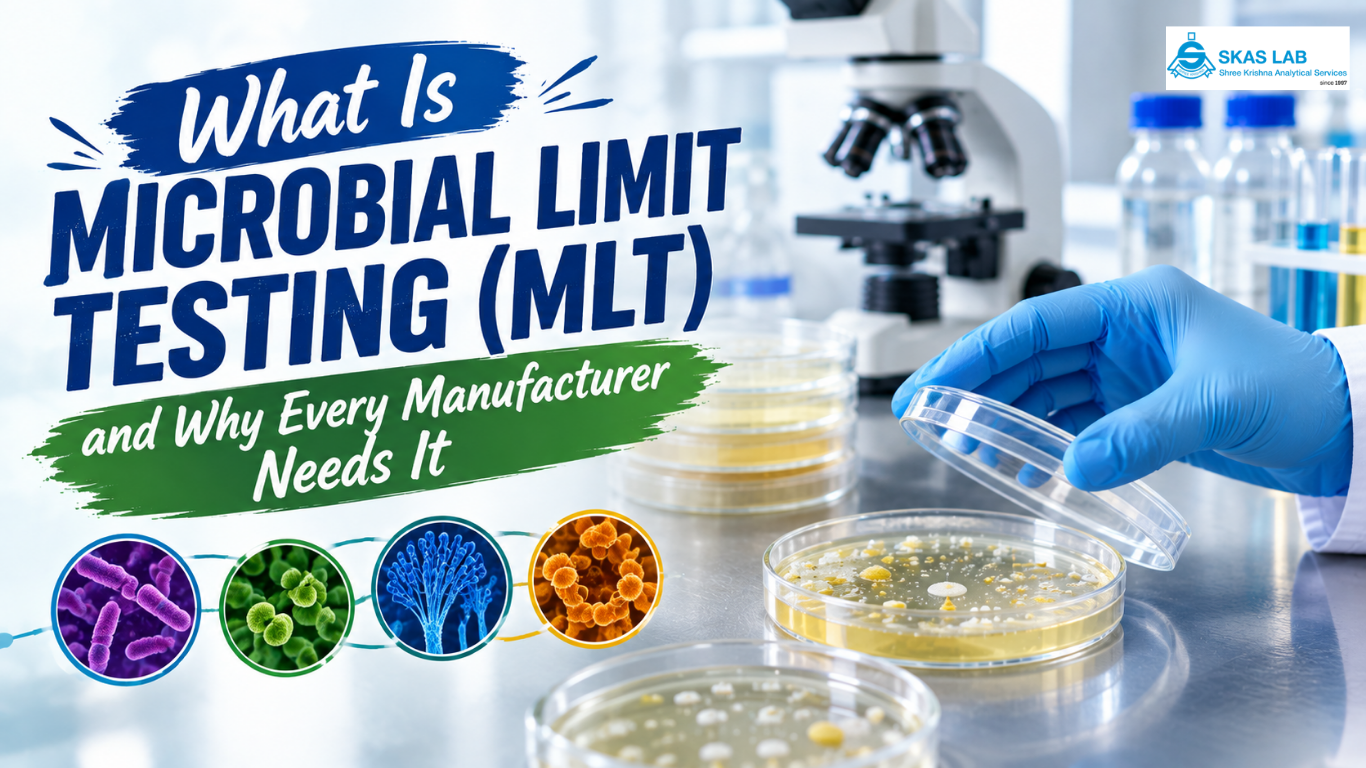
What Is Microbial Limit Testing? A Manufacturer's Guide
A single vial of contaminated cough syrup can trigger a multi-state recall, cost a manufacturer millions, and severely endanger immunocompromised patients. To stop this from happening, quality control teams rely on Microbial Limit Testing. What is microbial limit testing? It is a quality control procedure that measures total aerobic bacteria, yeast, mold, and specified pathogens in non-sterile pharmaceutical, cosmetic, and consumer products, following USP 61 and 62 standards, to confirm formulations meet safety limits before release to patients and consumers. At SKAS LAB (Shree Krishna Analytical Services), our microbiological testing laboratory runs these exact protocols every day to keep non-sterile products safe.
What is microbial limit testing?
Microbial Limit Testing is a two-phase laboratory procedure used to quantify the total number of viable aerobic microorganisms and detect specified objectionable pathogens in non-sterile products. It tells a manufacturer exactly what is living in their raw materials or finished goods, ensuring the bioburden remains within safe, compendial boundaries.
Definition and core purpose of MLT
The core purpose of Microbial Limit Testing is to prove a non-sterile product is safe for consumer use. According to Pacific BioLabs, the test consists of a quantitative phase (Microbial Enumeration) and a qualitative phase (Test for Specified Microorganisms). The quantitative phase determines the total number of aerobic organisms and yeast/mold count. The qualitative phase determines the presence or absence of specific objectionable organisms. If a batch fails either phase, it stays quarantined.
How USP 61 and 62 define the test
The relevant standards for Microbial Limit Testing have been harmonized for the US, European, British, and Japanese markets. USP 61 handles the quantitative enumeration of mesophilic bacteria and fungi that grow under aerobic conditions. USP 62 handles the screening for objectionable microorganisms. Together, they form the global baseline for non-sterile product release.
Where MLT fits in the quality control workflow
Microbial Limit Testing happens late in the quality control workflow, but it depends on early preparation. Before routine testing begins, you must validate the method. Scientech Labs notes that USP requires a suitability test prior to conducting testing on any product to ensure the product is not inhibiting the recovery of microorganisms, which prevents false negatives. Once validated, Microbial Limit Testing is performed on raw materials, in-process samples, and finished products just before batch release.
What is the MLT process step by step?
The Microbial Limit Testing process requires sample preparation, quantitative enumeration of microbes, and qualitative screening for pathogens. You must execute these steps aseptically to avoid extrinsic microbial contamination that could invalidate the results.
Sample preparation and dilution
You start by weighing 10 grams of solid material or withdrawing 10 milliliters of liquid material. The sample is transferred into 90 milliliters of sterile sodium chloride-peptone buffer and mixed well. If the product has antimicrobial properties, those properties must be neutralized, filtered, or diluted out completely before testing begins.
Total Aerobic Microbial Count (TAMC) method
For the Total Aerobic Microbial Count, you add 1 milliliter of the diluted buffer into a sterile petri dish. You then pour sterile tryptone soya bean digest agar media, cooled to 45°C, over the sample. The plates are inverted and incubated at 30 to 35°C for 3 to 5 days. You then count the resulting colonies to determine the total bacterial bioburden.
Total Yeast and Mold Count (TYMC) method
The Total Yeast and Mold Count follows a similar plating method but uses different media and conditions. You add 1 milliliter of the diluted sample into a sterile petri dish and pour sterile Sabouraud dextrose agar. These plates are inverted and incubated at 20 to 25°C for 5 to 7 days to allow fungal growth to emerge.
Test for specified (objectionable) microorganisms
Beyond counting total microbes, Microbial Limit Testing screens for specific pathogens. According to the harmonized standards, labs test for the presence or absence of Escherichia coli, Salmonella species, Staphylococcus aureus, Pseudomonas aeruginosa, bile tolerant gram-negative bacteria, Candida albicans, and Clostridia. The US FDA has also advised manufacturers of non-sterile, water-based drug products about the significant risk that Burkholderia cepacia complex poses to patients with compromised immune systems.
What are the USP limits for microbial testing?
USP limits for microbial testing are the maximum allowable colony counts and the required absence of specific pathogens, set based on the product's route of administration. A product passes only if its quantitative counts fall below the threshold and all specified pathogens are absent.
Acceptance criteria by dosage form and route of administration
Acceptance criteria depend entirely on how a patient uses the product. A topical ointment applied to broken skin demands stricter pathogen control than an oral tablet. According to the harmonized USP 61 and 62 guidelines, the tests are designed to determine whether a substance complies with an established specification for microbiological quality. If the specification for a specific dosage form dictates no more than 100 CFU per gram, a result of 101 CFU means the batch fails.
How limits differ for oral, topical, and mucosal products
Oral products generally tolerate higher total aerobic counts than topical products. Mucosal products sit in the middle. The European Pharmacopoeia and IPC 2.2.9 monograph outline these exact tolerances. For example, an oral liquid might permit a certain CFU limit for total aerobic microbes, but it must absolutely exclude E. coli. A topical preparation must exclude Staphylococcus aureus and Pseudomonas aeruginosa.
What does 10 CFU mean in a microbial limit test result?
10 CFU means a technician counted ten distinct colonies of microorganisms growing on an agar plate, indicating a very low bioburden in the tested sample volume. CFU stands for Colony Forming Units, the standard measurement used to estimate the number of viable bacteria or fungi in a product.
Understanding colony-forming units (CFU)
A single CFU represents one viable microorganism (or a cluster of them) that was capable of multiplying on the agar plate to form a visible colony. When a Microbial Limit Testing report shows 10 CFU, it means the specific dilution of the sample yielded exactly ten colonies. According to USP guidelines, you must calculate the count per gram or per milliliter based on your dilution factor. Ten colonies on a 1:10 dilution plate equals 100 CFU per gram in the original sample.
Interpreting low-count versus high-count results
A low-count result, like 10 CFU, suggests good manufacturing practices are effectively controlling the environment. A high-count result indicates a breach in the manufacturing process, contaminated raw materials, or a failing HVAC system. High counts trigger immediate investigation. You cannot simply release a product with a failing count; you must identify the root cause and discard the contaminated batch.
What are the microbial limit testing requirements for manufacturers?
Manufacturers must comply with strict microbial limit testing requirements for manufacturers, which include validating methods, adhering to pharmacopeial standards, and documenting every batch release. These requirements are non-negotiable for legal market distribution.
Regulatory frameworks: USP, European Pharmacopoeia, and IPC 2.2.9
Global regulatory frameworks align closely. Manufacturers in the US follow USP 61 and 62. In Europe, they follow the European Pharmacopoeia. In India, the Indian Pharmacopoeia Commission dictates the IPC 2.2.9 monograph for microbial contamination in non-sterile products. A manufacturer exporting globally must ensure their Microbial Limit Testing satisfies the strictest applicable standard among these harmonized texts.
Batch release and stability testing obligations
Microbial Limit Testing is a mandatory checkpoint for batch release. A QA manager cannot sign off on a finished product without a passing MLT certificate. Labs also pull samples from stability chambers at defined intervals to run Microbial Limit Testing over the product's shelf life, ensuring the formulation's preservative system continues to suppress microbial growth over time.
Documentation, validation, and method suitability
Regulators expect exhaustive documentation. According to Pacific BioLabs, Microbial Limit Testing is typically performed following cGMP and should be conducted by a GMP microbiology laboratory. You must validate your method suitability testing to prove the product does not inhibit microbial recovery. If antimicrobial properties are present, you must document how you neutralize them via dilution, filtration, or chemical inactivation. At SKAS Lab, our microbiologists document every validation step for full regulatory traceability.
Why is microbial limit testing for pharmaceutical products essential?
Microbial limit testing for pharmaceutical products is essential because it prevents contaminated medicines from reaching patients, avoids costly recalls, and verifies the integrity of non-sterile formulations. It acts as the final biological firewall before a product leaves the facility.
Protecting patient and consumer safety
Patient safety is the entire point. A patient taking a contaminated pharmaceutical product risks severe infection. The US FDA has explicitly warned drug manufacturers of non-sterile, water-based drug products about the significant risk that Burkholderia cepacia complex continues to pose. Patients exposed to BCC contamination face an increased risk of illness, especially those with compromised immune systems. Microbial Limit Testing catches these threats before consumption.
Preventing contamination-related recalls
Failing to test guarantees eventual recalls. Recalls destroy brand equity and cost millions in logistics and destroyed inventory. Routine Microbial Limit Testing catches a contaminated batch while it is still sitting in the manufacturer's warehouse. Finding the problem internally is always cheaper than pulling products from pharmacy shelves.
Non-sterile versus sterile product considerations
Do not confuse Microbial Limit Testing with sterility testing. Sterile products, like injectables, undergo a strict sterility test where absolutely no microbial growth is permitted. Non-sterile products, like oral tablets or topical creams, do not require absolute sterility. They do, however, require Microbial Limit Testing to ensure the bioburden remains below dangerous thresholds and that specific pathogens are entirely absent. To see how a dedicated facility handles this process end to end, read our blog on what a pharmaceutical testing lab does and why it's essential for drug safety.
How do manufacturers choose microbial limit testing services in India?
Manufacturers should choose microbial limit testing services India based on the laboratory's NABL accreditation, adherence to GLP standards, turnaround times, and the technical depth of their microbiology reporting. Selecting the right lab determines how quickly a product reaches the market.
Accreditation, turnaround time, and reporting standards
A lab must hold proper accreditation. Look for NABL-accredited laboratories that follow Good Laboratory Practice. Turnaround time is critical for batch release. If a lab takes three weeks to return an MLT report, your product sits in quarantine, costing you cash flow. You need a lab that provides clear, defensible documentation showing exactly which USP or IPC 2.2.9 methods were used and how the final CFU counts were calculated.
What to look for in a GLP/NABL-certified microbiology lab
Evaluate the lab's method suitability testing experience. A good lab knows how to neutralize the antimicrobial properties of your specific formulation. Ask how they handle BCC screening for water-based products. A partner lab should act as an extension of your quality team, catching what you might miss.
At SKAS LAB (Shree Krishna Analytical Services), we know that accurate Microbial Limit Testing is the backbone of pharmaceutical quality control. Our team ensures your non-sterile products meet USP 61, USP 62, and IPC 2.2.9 requirements without slowing down your batch release.
Ready to validate your methods and secure your supply chain? Contact SKAS Lab today.
Follow us on Facebook for more lab testing updates and you can also connect with us on LinkedIn.
Key Takeaways
- Microbial Limit Testing (MLT) quantifies viable microbes and detects specified pathogens in non-sterile pharmaceuticals.
- The process follows harmonized USP <61> and <62> standards, alongside regional guidelines like IPC 2.2.9.
- Acceptance criteria depend on the dosage form, with oral products tolerating higher bioburden than topical preparations.
- Routine MLT prevents costly recalls by catching contamination internally before batch release.
- Manufacturers must validate method suitability to ensure product antimicrobial properties do not cause false negatives.
Comparison of Microbial Limit Acceptance Criteria
| Product Route | Typical Total Count Limit | Required Absent Pathogens |
|---|---|---|
| Oral | Higher tolerance (e.g., 1000 CFU/g) | Escherichia coli, Salmonella |
| Topical | Lower tolerance (e.g., 100 CFU/g) | Staphylococcus aureus, Pseudomonas aeruginosa |
| Mucosal | Intermediate tolerance | Pseudomonas aeruginosa, Staphylococcus aureus |
| Water-based Non-Sterile | Strictly controlled | Burkholderia cepacia complex |
Frequently Asked Questions
What is microbial limit testing?
Microbial limit testing is a quality control procedure that quantifies total aerobic bacteria, yeast, and mold in non-sterile products. It also detects specified pathogens to ensure formulations meet compendial safety limits before consumer release, preventing contaminated goods from reaching the market.
What is the MLT process?
The process involves preparing and diluting a sample, then conducting a Total Aerobic Microbial Count and a Total Yeast and Mold Count. Finally, labs perform qualitative screening for objectionable pathogens like E. coli, Salmonella, and Pseudomonas aeruginosa to ensure product safety.
What are the USP limits for microbial testing?
USP limits dictate the maximum allowable colony counts and require the absence of specific pathogens based on the product's route of administration. For example, oral products might tolerate higher aerobic counts than topicals, but absolutely exclude pathogens like E. coli for patient safety.
What does 10 CFU mean in microbial limit testing?
10 CFU means a technician counted ten distinct colonies of microorganisms growing on an agar plate. CFU stands for Colony Forming Units. A low count like this indicates good manufacturing practices and a very low bioburden in the tested sample volume.
Why is microbial limit testing for pharmaceutical products essential?
Microbial limit testing for pharmaceutical products prevents contaminated medicines from reaching patients, avoids costly recalls, and verifies non-sterile formulation integrity. It acts as the final biological firewall to catch dangerous pathogens before a product leaves the manufacturing facility.
