
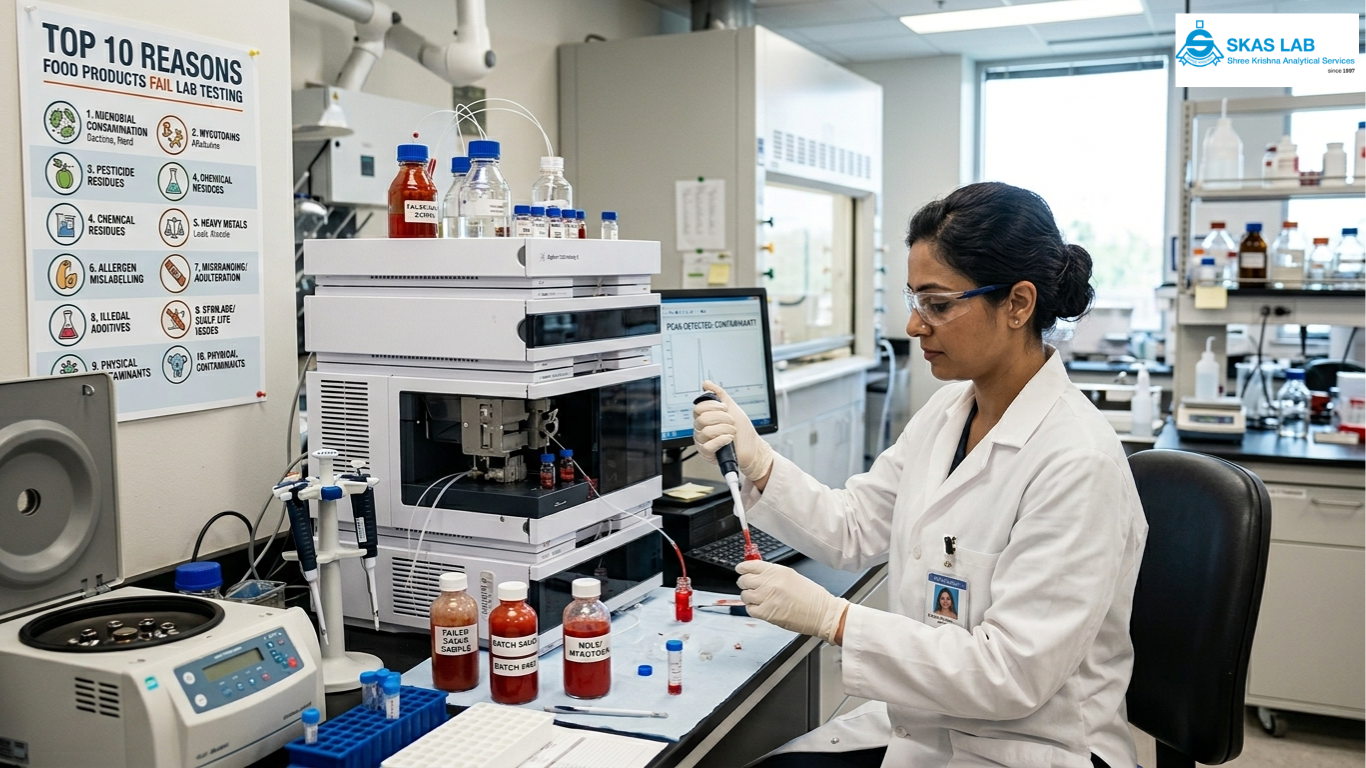
Top 10 Reasons Food Products Fail Lab Testing (Real Case Insights)
Food safety is one of the most critical aspects of the food industry. Every product that reaches consumers must pass strict quality checks under the food safety and standards act 2006. However, many food products fail when tested in a Food testing laboratory leading to financial losses, regulatory penalties and brand damage.
Whether you are a manufacturer, exporter or startup understanding why products fail in a food sample testing lab is essential. In this blog, we will explore the top 10 real-world reasons behind lab test failures and how businesses can avoid them with proper quality control
Why Food Testing Is Mandatory in India
Before diving into failure reasons, it is important to understand why testing is crucial. Under the food safety and standards act 2006, all food products must meet defined safety, hygiene, and quality parameters. A Certified food testing lab Delhi or any accredited lab ensures:
- Consumer safety
- Regulatory compliance
- Product consistency
- Export eligibility
Businesses searching for a food quality testing lab near me often do so after facing compliance issues. Proactive testing helps avoid such risks.
Top 10 Reasons Food Products Fail Lab Testing
Top 10 Reasons Food Products Fail Lab Testing
1. Microbial Contamination
One of the most common reasons for failure in a Food testing lab is microbial contamination.
What happens:
- Food samples show high levels of bacteria such as:
- E. coli
- Salmonella
- Listeria
Real insight: A dairy product batch failed due to improper refrigeration during transport, leading to bacterial growth.
How to prevent:
- Maintain cold chain logistics
- Follow hygiene protocols
- Conduct regular testing in a food sample testing lab
2. Presence of Adulterants
Adulteration is a serious violation under the food safety and standards act 2006.
Common adulterants:
- Artificial colors
- Starch in milk products
- Synthetic chemicals
Case example: A spice manufacturer failed testing due to the presence of non-permitted dyes.
Solution: Use verified raw materials and test samples regularly at a Certified food testing lab Delhi.
3. Incorrect Nutritional Labeling
Label claims must match actual product composition.
Issue:
- Mismatch between declared and tested values such as:
- Protein
- Fat
- Carbohydrates
Real case: A packaged snack failed because its protein content was significantly lower than stated.
Fix: Conduct pre-launch verification at a food quality testing lab near me.
4. High Pesticide Residues
Agricultural products often fail due to pesticide contamination.
Why it happens:
- Excess pesticide use
- Poor washing processes
Example: Export-quality fruits were rejected due to pesticide levels exceeding permissible limits.
Prevention:
- Source from trusted suppliers
- Perform testing in a Food testing lab
5. Heavy Metal Contamination
Heavy metals like lead, arsenic, and mercury pose serious health risks.
Sources:
- Contaminated water
- Industrial pollution
- Packaging materials
Case insight: A herbal product failed due to high lead content from raw material sourcing.
Solution: Routine testing in a food sample testing lab before distribution.
6. Improper Food Additives Usage
Using additives beyond permissible limits leads to immediate failure.
Common issues:
- Excess preservatives
- Unauthorized additives
Real example: A beverage failed due to overuse of sodium benzoate.
Best practice: Follow regulatory guidelines under the food safety and standards act 2006.
7. Poor Packaging Quality
Packaging plays a vital role in food safety.
Problems include:
- Leakage
- Contamination
- Chemical migration
Case example: Oil packaging failed due to chemical leaching from low-quality plastic.
Prevention: Test packaging materials at a Certified food testing lab Delhi.
8. Shelf-Life Failure
Products must remain safe throughout their shelf life.
What goes wrong:
- Early spoilage
- Change in taste, texture, or smell
Real insight: A bakery product failed because it developed mold before the declared expiry date.
Solution: Conduct shelf-life studies at a food quality testing lab near me.
9. Inconsistent Batch Quality
Variation between batches is a common issue.
Reasons:
- Lack of process control
- Raw material inconsistency
Case example: A packaged food brand failed because different batches showed varying fat content.
Fix: Implement quality checks and test each batch in a Food testing lab.
10. Non-Compliance with Regulatory Standards
Failure to meet legal standards leads to rejection.
Issues include:
- Missing documentation
- Non-compliant ingredients
- Improper labeling
Example: A startup product failed due to incomplete compliance with the food safety and standards act 2006.
Solution: Work with a Certified food testing lab Delhi for compliance support.
How SKAS Lab Helps Prevent Food Test Failures
A reliable Food testing lab plays a crucial role in ensuring product success.
At SKAS Lab, businesses benefit from:
- Advanced testing infrastructure
- Accurate and fast reports
- Regulatory compliance guidance
- End-to-end support
Explore services: https://skaslab.com/
Get assistance: https://skaslab.com/contact-us.html
Best Practices to Avoid Lab Test Failures
To ensure your product passes every food sample testing lab evaluation, follow these steps:
- Use high-quality raw materials
- Maintain strict hygiene standards
- Validate formulations before production
- Conduct regular batch testing
- Ensure proper storage and transportation
- Follow labeling guidelines
- Stay updated with the food safety and standards act 2006
Importance of Choosing the Right Testing Laboratory
Selecting the right food quality testing lab near me can make a significant difference.
Look for:
- Accreditation and certification
- Experienced professionals
- Advanced testing equipment
- Transparent reporting
A trusted Certified food testing lab Delhi ensures reliable results and compliance.
Future Trends in Food Testing
The food testing industry is evolving rapidly.
Emerging trends:
- Rapid testing technologies
- AI-based quality analysis
- Blockchain for traceability
- Real-time monitoring systems
These advancements will reduce failure rates and improve food safety standards.
FAQs
1. Why do food products fail in a Food testing lab?
Food products fail due to contamination, incorrect labeling, adulteration, or non-compliance with safety standards.
2. What is the role of a food sample testing lab?
A food sample testing lab analyzes food for safety, quality, and compliance with regulations.
3. What is the food safety and standards act 2006?
It is the primary law governing food safety and quality standards in India.
4. How can I find a food quality testing lab near me?
You can search online or choose a reputed Certified food testing lab Delhi for accurate and reliable testing.
5. What tests are performed in a Food testing lab?
Tests include microbiological analysis, chemical testing, pesticide residue testing, and nutritional analysis.
6. How often should food products be tested?
Products should be tested regularly—especially before launch and during batch production.
7. Can small businesses use food testing labs?
Yes, startups and small businesses can use a food sample testing lab to ensure compliance and product quality.
Final Thoughts
Failing a lab test can be costly, but it is also preventable. Understanding the common reasons behind failure in a Food testing lab helps businesses take proactive measures. From contamination to labeling errors, each issue can be addressed with proper quality control and regular testing.
By working with a reliable Certified food testing lab Delhi and following the food safety and standards act 2006, businesses can ensure product safety, maintain compliance, and build consumer trust. Investing in testing is not just a requirement—it is a strategic decision for long-term success.
