
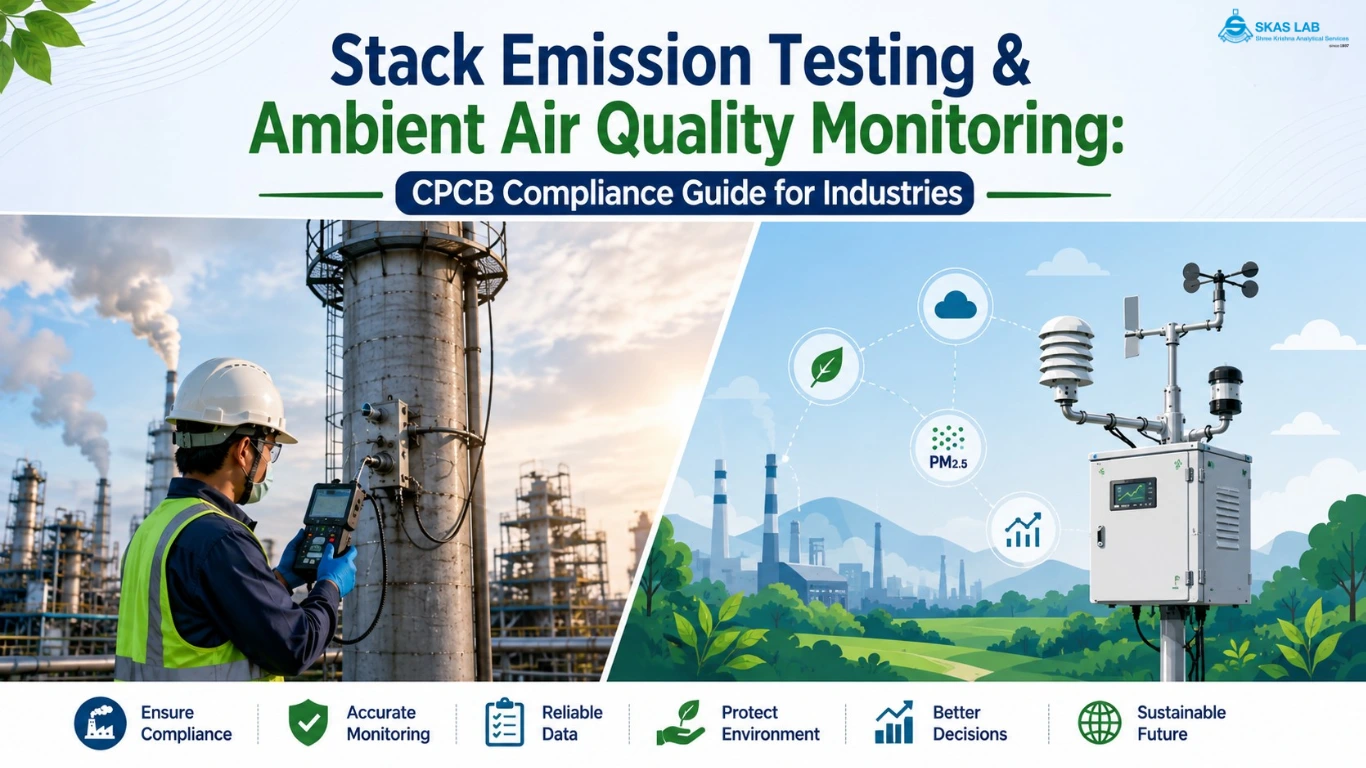
Stack Emission Testing & Ambient Air Quality Monitoring: Complete CPCB Compliance Guide for Industries
Industrial growth is essential for economic development, but it also creates environmental responsibilities that industries cannot ignore. Manufacturing facilities, power plants, chemical processing units, pharmaceutical industries, food processing plants, textile units, and metal processing facilities generate emissions that can significantly impact air quality if not properly monitored and controlled.
This is where Stack Emission Testing, Ambient Air Quality Monitoring, and Environmental Compliance Testing become critical. Regulatory authorities in India, including the Central Pollution Control Board (CPCB) and State Pollution Control Boards (SPCBs), require industries to monitor emissions and maintain compliance with prescribed environmental standards.
Regular Industrial Air Quality Testing helps organizations evaluate pollutant levels, improve pollution control efficiency, meet CPCB requirements, and protect both public health and the environment. Beyond regulatory compliance, environmental monitoring supports sustainability initiatives, ESG goals, operational efficiency, and long-term risk management.
Why Stack Emission Testing and Ambient Air Quality Monitoring Matter
Air pollution remains one of the most pressing environmental challenges worldwide. Industrial operations release pollutants such as particulate matter, sulfur oxides, nitrogen oxides, carbon monoxide, and volatile organic compounds (VOCs), which can affect ecosystems, employees, and nearby communities.
Key Reasons Industries Must Monitor Emissions
- Compliance with CPCB and SPCB regulations
- Improved environmental compliance management
- Protection of worker and community health
- Prevention of environmental penalties and legal action
- Support for ESG and sustainability goals
- Enhanced operational efficiency
- Better stakeholder confidence and corporate reputation
- Early identification of pollution control system failures
Organizations that invest in regular Stack Monitoring Services often discover process inefficiencies that can be corrected, resulting in environmental and financial benefits.
What is Stack Emission Testing? Procedure, Parameters and Benefits
Stack Emission Testing is the process of measuring pollutants released from industrial chimneys, stacks, boilers, furnaces, DG sets, incinerators, and process vents. The objective is to verify whether emissions remain within CPCB-prescribed limits and to assess the effectiveness of pollution control systems.
Common Parameters Measured During Stack Emission Testing
- Particulate Matter (PM)
- Sulfur Dioxide (SO₂)
- Nitrogen Oxides (NOx)
- Carbon Monoxide (CO)
- Carbon Dioxide (CO₂)
- Oxygen (O₂)
- Volatile Organic Compounds (VOCs)
- Heavy Metals
- Temperature
- Velocity and Flow Rate
The results help industries demonstrate compliance during inspections and maintain effective pollution control operations.
Stack Emission Testing Procedure
Understanding the stack emission testing procedure helps industries prepare for regulatory audits and environmental assessments.
1. Site Inspection
Environmental experts evaluate stack design, accessibility, sampling ports, and operating conditions.
2. Sampling Point Selection
Sampling locations are selected according to CPCB guidelines to ensure representative emission measurements.
3. Isokinetic Stack Sampling
Specialized equipment is used to collect particulate samples while maintaining equal sampling velocity.
4. Pollutant Measurement
Parameters such as PM, SO₂, NOx, CO, VOCs, and heavy metals are measured using calibrated instruments.
5. Data Analysis
Collected samples are analyzed using approved environmental testing methodologies.
6. Compliance Reporting
Results are compared with applicable CPCB stack emission standards and documented in detailed reports.
What is Ambient Air Quality Monitoring and Why is it Important?
Ambient Air Quality Monitoring evaluates the quality of air surrounding an industrial facility. Unlike stack emission testing, which measures pollutants at the source, ambient monitoring determines pollutant concentrations in the surrounding environment.
Common Ambient Air Parameters
- PM10
- PM2.5
- Sulfur Dioxide (SO₂)
- Nitrogen Dioxide (NO₂)
- Ozone (O₃)
- Carbon Monoxide (CO)
- Ammonia (NH₃)
- Lead and Other Heavy Metals
Ambient air monitoring helps industries assess environmental impact, protect nearby communities, and comply with National Ambient Air Quality Standards (NAAQS).
CPCB Requirements Industries Must Follow
The Central Pollution Control Board (CPCB) establishes environmental standards that industries must follow.
Industries Commonly Requiring Monitoring
- Power Plants
- Cement Manufacturing Units
- Pharmaceutical Industries
- Food Processing Facilities
- Chemical Manufacturing Plants
- Textile Industries
- Steel and Metal Processing Units
- Waste Treatment and Disposal Facilities
Monitoring frequency depends on industry category, pollution potential, environmental clearance conditions, and SPCB consent requirements.
Consequences of Non-Compliance
- Environmental notices
- Financial penalties
- Legal proceedings
- Suspension of operations
- Revocation of environmental clearances
- Increased regulatory scrutiny
CPCB Stack Emission Standards: Why Compliance Matters
CPCB has established industry-specific limits for particulate matter, sulfur dioxide, nitrogen oxides, and other pollutants.
Regular Industrial Emission Testing Helps Organizations
- Verify compliance with CPCB standards
- Avoid environmental penalties
- Improve pollution control efficiency
- Maintain environmental clearances
- Support sustainable industrial operations
Industries should periodically review applicable CPCB notifications and consent conditions to ensure continuous compliance.
Technologies Used in Modern Environmental Monitoring
Environmental monitoring technologies have advanced significantly in recent years.
Advanced Monitoring Technologies
- Isokinetic Stack Sampling Systems
- Continuous Emission Monitoring Systems (CEMS)
- Continuous Ambient Air Quality Monitoring Stations (CAAQMS)
- High Volume Air Samplers
- Respirable Dust Samplers
- Gas Analyzers
- Meteorological Monitoring Instruments
- Real-Time Air Quality Sensors
These technologies provide accurate and reliable environmental data for regulatory compliance and operational decision-making.
Benefits of Hiring a NABL Accredited Environmental Testing Laboratory
Selecting a NABL Accredited Environmental Laboratory ensures testing accuracy, reliability, and regulatory acceptance.
Benefits Include
- Standardized testing methodologies
- Calibrated instruments
- Qualified environmental professionals
- Legally defensible reports
- Improved compliance confidence
- Better audit preparedness
Accredited laboratories play a critical role in helping industries maintain environmental compliance and reduce operational risks.
Common Mistakes Industries Make During Environmental Monitoring
1. Infrequent Testing
Waiting until inspections occur often results in compliance gaps.
2. Ignoring Small Deviations
Minor exceedances may indicate larger process problems.
3. Poor Documentation
Missing records can create compliance issues even when emissions remain within limits.
4. Inadequate Equipment Maintenance
Pollution control equipment requires regular inspection and servicing.
5. Delayed Corrective Actions
Failure to act on environmental reports can result in recurring violations.
How Environmental Monitoring Supports ESG and Sustainability Goals
Environmental monitoring has become an important component of ESG reporting and sustainability programs.
Benefits Include
- Reduced environmental impact
- Improved ESG performance
- Better investor confidence
- Enhanced stakeholder trust
- Stronger regulatory relationships
- Support for sustainability reporting
Organizations that proactively invest in environmental monitoring are often better positioned to meet future environmental requirements.
Frequently Asked Questions
What is stack emission testing?
Stack emission testing measures pollutants released from industrial stacks, chimneys, and vents to verify compliance with environmental regulations.
What are CPCB stack emission standards?
CPCB stack emission standards define permissible limits for pollutants such as particulate matter, sulfur dioxide, and nitrogen oxides for different industries.
How often should industries conduct stack emission testing?
Monitoring frequency depends on CPCB guidelines, industry category, environmental clearance conditions, and SPCB consent requirements.
What is the difference between stack emission testing and ambient air monitoring?
Stack emission testing measures pollutants at the source, while ambient air monitoring evaluates air quality in the surrounding environment.
Is ambient air quality monitoring mandatory?
Many industries are required to conduct ambient monitoring under environmental clearance and consent conditions.
Why choose a NABL accredited environmental testing laboratory?
NABL accredited laboratories follow standardized testing procedures and quality systems, ensuring reliable and legally acceptable results.
Can environmental testing improve operational efficiency?
Yes. Environmental monitoring often identifies inefficiencies in combustion systems, filtration units, and pollution control equipment.
How does environmental monitoring support ESG goals?
Environmental monitoring demonstrates environmental responsibility, regulatory compliance, and commitment to sustainability initiatives.
Conclusion
Stack Emission Testing, Ambient Air Quality Monitoring, and Environmental Compliance Testing are essential components of responsible industrial operations. Beyond regulatory compliance, they help organizations protect public health, improve operational efficiency, reduce environmental risks, and strengthen sustainability initiatives.
As environmental regulations continue to evolve, proactive monitoring becomes increasingly important. Industries that invest in regular environmental assessments, accurate reporting, and timely corrective actions are better positioned to maintain compliance with CPCB requirements and achieve long-term sustainability objectives.
For businesses seeking environmental compliance support, partnering with an experienced environmental testing laboratory can provide reliable data, technical expertise, and valuable insights for informed decision-making.
