
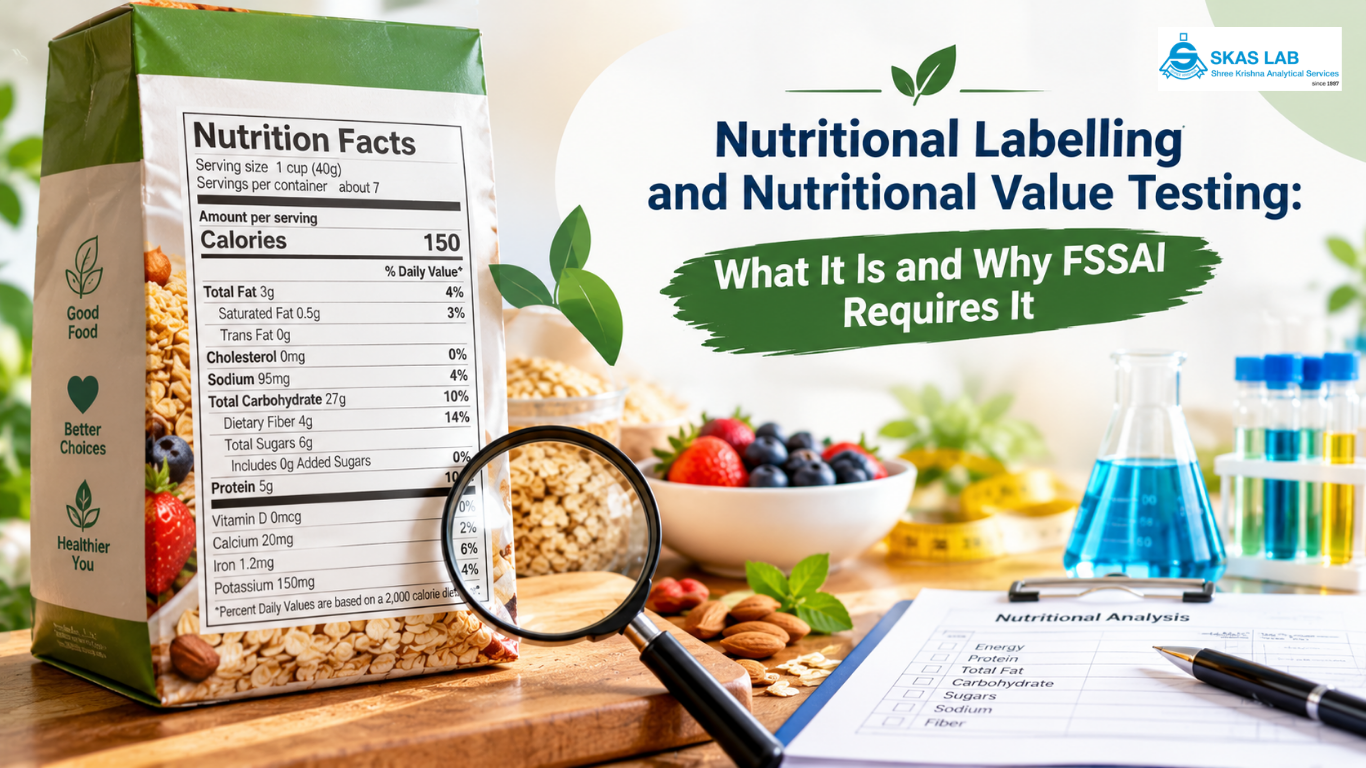
Nutritional Labelling and Nutritional Value Testing: What It Is and Why FSSAI Requires It
A 2024 industry eBook from ESHA Research notes that accurate product labels are necessary for building consumer trust and complying with truth-in-advertising laws. Yet many food businesses still guess their numbers. Nutritional value testing is the scientific process of analyzing food products to determine their exact nutrient content, including macronutrients, vitamins, and minerals. FSSAI requires this testing to ensure nutritional labelling requirements are met, verifying that food businesses provide accurate, compliant, and transparent dietary information to consumers. If you manufacture packaged food in India, you cannot print a label without it.
What is Nutritional Value Testing for Food Products?
Nutritional value testing for food products is the exact scientific measurement of a food item's macronutrients and micronutrients. It physically analyzes a sample to determine calories, fat, protein, carbohydrates, vitamins, and minerals, providing the raw data needed to generate a compliant Nutrition Facts panel.
According to FARE Labs, this process is also known as nutritional analysis. It measures specific amounts of nutrients present in a food product. This includes the macronutrients that make up the bulk of our diets, like carbohydrates, protein, and fat. It also isolates the critical micronutrients—vitamins and minerals—that regulators require on packaging.
The core components of nutritional analysis
A comprehensive test analyzes a broad spectrum of nutrients. According to Element, a global testing provider, core testing capabilities cover fat, protein, moisture, ash, carbohydrates, calories, and sodium.
A standard panel typically breaks down into three areas:
- Macronutrients: Total carbohydrates, dietary fiber, sugars, protein, and fats (including saturated, unsaturated, and trans fats).
- Micronutrients: Vitamins A, C, D, E, and the B group, alongside minerals like calcium, iron, sodium, and potassium.
- Additional components: Cholesterol, moisture content, and ash.
Difference between laboratory testing and database analysis
You can calculate nutritional values two ways. You can send a physical sample to a lab, or you can use software to calculate values based on a recipe.
Laboratory analysis is specific, comprehensive, and exact. It provides a detailed breakdown of the food in its current state. This is critical for heavily processed items. Take a fried product. Without lab analysis, it is nearly impossible to determine how the ingredients altered during cooking and exactly how much oil remains in the final product.
Database analysis is fast. You enter ingredient amounts, and the software returns a nutrient profile. But software relies on generic averages. It does not account for real-world variables like cooking times or supplier variations. When accuracy and regulatory compliance are on the line, direct laboratory testing is the superior choice.
Why Does FSSAI Require Nutritional Labelling?
FSSAI mandates nutritional labelling to safeguard public health and ensure fair trade practices. The Food Safety and Standards Authority of India requires verified data so consumers receive transparent, accurate dietary information, preventing food businesses from making unsubstantiated health claims.
Government regulations mandate specific testing for various food products. These regulations exist to protect the consumer. If a brand claims its cereal is high in iron, the regulator needs proof.
Mandatory compliance for packaged foods
If you sell pre-packaged food, you must comply. FSSAI nutritional labelling requirements dictate that any packaged food item intended for human consumption must display specific nutrient information. This is not voluntary.
According to the ESHA Research eBook, many countries require the display of nutrient content on packaged foods. The FDA in the United States expects companies to perform due diligence and report information as accurately as possible. FSSAI operates on the exact same principle. You must prove what is in your package before it hits the shelf.
Protecting consumer health and preventing misleading claims
Accurate labels empower consumers to make informed dietary decisions. Testing ensures labels reflect the true nutritional content of a product, considering factors like processing methods and ingredient variations.
A food manufacturer might leverage nutritional testing during product development to fine-tune formulations. But the end goal is consumer protection. Without enforced labelling, a company could market a sugar-heavy snack as a healthy protein bar. Verified testing stops that.
What Are the FSSAI Nutritional Labelling Requirements?
FSSAI nutritional labelling requirements mandate that packaged food display specific nutrient values per 100 grams or 100 milliliters, plus per serving. This data must appear on the packaging in a standardized format, adhering to strict thresholds for any health or nutrient content claims.
The specific rules govern what you must print, how you must print it, and what you can legally claim.
Mandatory nutrients to declare on the label
Standard laboratory tests for nutrition labeling include a specific set of required nutrients. According to Eurofins, a global laboratory network, the standard tests required on a food item for nutrition labeling include calories, total fat, saturated fat, trans fat, cholesterol, sodium, total carbohydrates, dietary fiber, total sugars, added sugars, protein, vitamin D, calcium, iron, and potassium.
FSSAI requires a similar core set of mandatory declarations. You must declare energy value in kcal, the amounts of protein, carbohydrates, and fat, alongside the breakdown of trans fats and saturated fats.
Formatting rules for the Nutrition Facts panel
How you present the data matters just as much as the data itself. Eurofins notes that labs can create photo-ready labels in various formats. The data must comply with specific regulatory standards.
In India, the Nutrition Facts panel must follow the exact layout FSSAI prescribes. You list the serving size first. Then you provide the per-serving amounts for all mandatory nutrients. The format demands clarity. If a lab generates your data, they often provide a formatted, compliant panel ready for your packaging designer.
Thresholds for health and nutrient content claims
You cannot just print "High Protein" on a label. You must hit a specific numerical threshold.
If a brand wants to claim a product is a "rich source" of a vitamin, the product must contain at least 30% of the Recommended Daily Allowance (RDA) for that nutrient. If it contains 15% to 30%, it qualifies as a "source." Nutritional value testing provides the exact number that proves your product meets that legal threshold.
How Does a Food Nutritional Analysis Laboratory Perform the Testing?
A food nutritional analysis laboratory performs testing by physically processing a submitted food sample and applying validated chemical methods—such as High-Performance Liquid Chromatography—to isolate and measure exact vitamin and mineral quantities.
The process is highly technical. It requires specialized equipment and strict protocols.
Sample preparation and submission protocols
It starts with you. You must manufacture a physical sample of your product and send it to the lab.
According to Eurofins, products sent for analysis must be accompanied by a detailed questionnaire. This questionnaire targets key areas where testing might change or adjustments might be necessary for compliance. Clients should provide a comprehensive list of the product's ingredient formulation. The lab uses this to determine exactly which tests to run.
Once the lab receives the sample, they prepare it. They homogenize the food. They blend it into a uniform state so that every tiny portion they test accurately represents the whole batch.
Analytical methods used to isolate vitamins and minerals
Labs do not guess. They use industry-recognized methodologies. According to Element, these include AOAC, AOCS, EPA, and USP protocols.
To measure fat, they might use solvent extraction. For protein, they measure nitrogen content using the Dumas method or the Kjeldahl method. To isolate specific vitamins and minerals, they often use High-Performance Liquid Chromatography (HPLC) or mass spectrometry. These tools separate the complex food matrix into its individual chemical components. The lab then measures the exact mass of each nutrient.
When Should a Food Business Conduct Nutritional Value Testing?
A food business must conduct nutritional value testing before launching a new product, and again whenever they reformulate an existing recipe or change ingredient suppliers. Testing at these critical points ensures the label remains legally accurate and compliant.
Timing is everything. If you test too early, recipe tweaks will invalidate your data. If you test too late, you miss your launch date.
Before launching a new product to the market
You need a label before you print packaging. You need data before you create a label.
According to the ESHA Research eBook, obtaining an accurate nutritional analysis of your food product is an important step in getting your product to the marketplace. It is mandatory for regulatory compliance. You must finalize your exact recipe, manufacture a physical sample of that final product, and send it to the lab. Do not test a prototype. Test the exact product consumers will buy.
When reformulating existing recipes or changing suppliers
Recipes change. A manufacturer might swap out a supplier for a cheaper alternative. They might reduce sugar to meet a new dietary trend.
Every time you modify an ingredient, you have to pay for a new analysis. Even if the change seems minor, ingredient variations alter the final nutrient profile. If you change suppliers for your flour, the protein content might shift. If you do not retest, your label is now legally inaccurate.
How to Choose the Right Laboratory for Nutritional Value Testing?
To choose the right laboratory for nutritional value testing, verify that the facility holds NABL and ISO 17025 accreditations and uses FSSAI-recognized testing protocols. These credentials prove the lab operates at the highest standard of analytical credibility.
Not all labs are equal. You are trusting them with your legal compliance.
Looking for NABL and ISO 17025 accreditations
Accreditation is the baseline. According to FARE Labs, a credible lab holds accreditation as per ISO/IEC 17025:2017 by NABL.
ISO 17025 is the main standard used by testing and calibration laboratories. It proves the lab's technical competence and quality management systems. According to FSNS, their nutritional testing labs are ISO 17025-accredited to perform testing for global requirements. If a lab lacks this accreditation, FSSAI will not recognize their data. Walk away.
Ensuring FSSAI-recognized testing protocols
The lab must use methods FSSAI accepts. Element notes that they employ industry-recognized methodologies including AOAC, AOCS, EPA, and USP protocols. These are exactly the validated methods regulators expect.
Ask the lab for their method validation reports. Ask them if they have experience with FSSAI's specific packaging and labelling regulations. A good lab will not just hand you a spreadsheet of numbers. They will provide a Certificate of Analysis (CoA) that certifies your product's nutritional content.
What Happens If a Brand's Nutritional Labels Are Inaccurate?
If a brand's nutritional labels are inaccurate, they face severe regulatory penalties, product recalls, and a rapid loss of consumer trust. FSSAI actively monitors the market, and non-compliance with labelling regulations destroys brand integrity almost overnight.
Inaccurate labels are not a minor clerical error. They are a legal violation.
Regulatory penalties and product recalls
FSSAI has the authority to pull non-compliant products from shelves. If an audit reveals your protein bar actually contains half the protein you claim, FSSAI can order a total product recall.
Recalls are expensive. You must retrieve the product from distributors and retailers at your own cost. You face hefty fines. In severe cases of misleading claims, authorities can suspend your manufacturing license.
Loss of consumer trust and brand reputation
The regulatory fine is often smaller than the market penalty. According to Food Lab, Inc., accurate product labels are fundamental to establishing and maintaining trust in your brand.
Consumers read labels. If a customer tracks their macros and realizes your label lied about the sugar content, they will not buy again. They will leave negative reviews. They will tell their network. A brand's reputation takes years to build and days to destroy. Accurate nutritional value testing is the shield that protects it.
Key Takeaways
- Nutritional value testing physically measures a food product's exact macronutrient and micronutrient content.
- FSSAI mandates nutritional labelling to protect consumers and prevent misleading health claims on packaged foods.
- Laboratory testing is superior to database analysis because it accounts for real-world processing variables.
- Brands must retest products whenever they reformulate recipes or change ingredient suppliers to maintain compliance.
- Always choose a laboratory with NABL and ISO 17025 accreditations to ensure FSSAI-recognized analytical credibility.
Comparison
| Analysis Method | How It Works | Best Used For | Regulatory Accuracy |
|---|---|---|---|
| Laboratory Testing | Physical sample analysis using chemical methods like HPLC | Processed, fried, or reformulated foods | Highly accurate and FSSAI-recognized |
| Database Analysis | Software calculates nutrients from recipe ingredient averages | Simple recipes, early product development | Generic estimates, not ideal for final labels |
Frequently Asked Questions
Is nutritional value testing mandatory for all food products in India?
Nutritional value testing is mandatory for all pre-packaged food products intended for human consumption in India. FSSAI requires accurate nutrient declarations on the label to ensure consumer transparency and regulatory compliance before products reach the market.
How much does nutritional value testing cost at an FSSAI-approved lab?
Lab analysis for nutrition facts typically averages between $800 and $1,000 per sample, with additional nutrients costing up to $100 each. In India, costs vary, but brands should expect a significant investment for accurate, ISO 17025-accredited testing.
How long does it take to get nutritional analysis results?
Laboratory nutritional analysis typically takes up to 30 days or more to complete. However, some specialized laboratories offer expedited services. Brands should plan their testing schedules carefully to avoid delaying their product launch or packaging printing timelines.
What is the difference between nutritional analysis and nutritional labelling?
Nutritional analysis is the scientific process of physically measuring a food sample's exact macronutrient and micronutrient content. Nutritional labelling is the process of formatting that verified data into a compliant Nutrition Facts panel for consumer packaging.
Can I use software to calculate nutritional values instead of lab testing?
You can use database software to calculate values based on generic ingredient averages. However, it cannot account for real-world variables like cooking times or processing methods, making direct laboratory testing the superior choice for strict regulatory compliance.
