
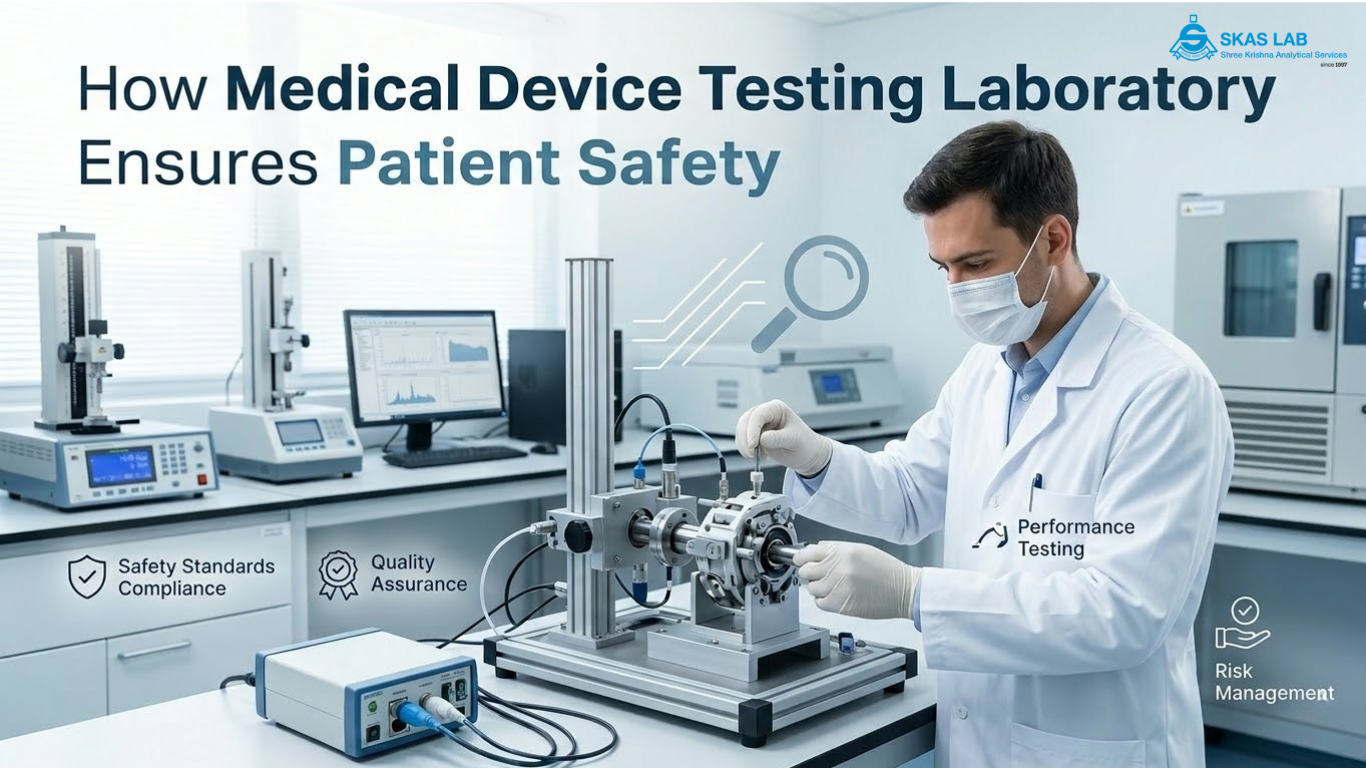
How Medical Device Testing Laboratory Ensures Patient Safety
In today’s healthcare ecosystem, patient safety is non-negotiable. Every medical device—from simple syringes to complex implants—must perform safely, effectively, and consistently. This is where a Medical Device Testing Laboratory plays a critical role. Before any device reaches hospitals or patients, it undergoes rigorous scientific testing to ensure it meets strict safety, performance, and regulatory standards.
With increasing regulatory scrutiny and global quality benchmarks, testing is no longer just a formality—it is a life-saving process. At SKAS Lab, advanced testing protocols, regulatory expertise, and scientific precision ensure that medical devices meet all necessary safety requirements before entering the market.
Why Medical Device Testing Is Critical for Patient Safety
Medical devices interact directly with the human body. Any defect, contamination, or material incompatibility can lead to serious health risks. A certified Medical Device Testing Laboratory ensures that devices are safe for intended use and free from harmful effects.
Key risks without proper testing:
- Device malfunction or failure
- Toxic material exposure
- Infection due to contamination
- Incorrect performance or inaccurate readings
- Long-term biological complications
Through medical device certification testing, these risks are identified and eliminated before devices are approved for use.
What is Medical Device Certification Testing?
Medical device certification testing is a structured evaluation process that ensures a device complies with national and international safety standards. This includes mechanical, chemical, biological, and performance testing. A Medical Device Testing Laboratory evaluates devices under controlled conditions to simulate real-world usage and stress factors.
Key objectives:
- Verify product safety and reliability
- Ensure compliance with regulatory bodies
- Validate material compatibility
- Assess durability and functionality
- Generate documented evidence for approval
This process is mandatory for manufacturers before launching products in the market.
Role of CDSCO Medical Device Testing in India
India’s medical device industry is regulated by the Central Drugs Standard Control Organization (CDSCO). Compliance with CDSCO medical device testing is essential for legal approval and market entry.
Why CDSCO compliance matters:
- Mandatory for device registration in India
- Ensures adherence to safety guidelines
- Protects patients from substandard products
- Aligns Indian standards with global norms
A professional Medical Device Testing Laboratory conducts tests as per CDSCO guidelines, helping manufacturers secure approvals efficiently.
ISO 10993 Biocompatibility Testing – Ensuring Safety Inside the Human Body
One of the most critical aspects of device safety is biological compatibility. ISO 10993 biocompatibility testing evaluates how a device interacts with human tissues.
Why biocompatibility testing is essential:
- Detects toxic or allergic reactions
- Evaluates irritation and sensitization
- Ensures safe long-term implantation
- Prevents inflammation or tissue damage
Common tests under ISO 10993 include:
- Cytotoxicity testing
- Sensitization testing
- Irritation testing
- Systemic toxicity
- Implantation studies
A certified Medical Device Testing Laboratory ensures that materials used in devices are safe for human use under all conditions.
NABL Accredited Testing Laboratory India – Why Accreditation Matters
Choosing a NABL accredited testing laboratory in India ensures that testing is conducted with the highest level of accuracy and reliability.
Benefits of NABL accreditation:
- Globally accepted test reports
- Standardized testing procedures
- Calibrated instruments and validated methods
- Reliable and reproducible results
- Increased trust from regulatory bodies
At SKAS Lab, NABL-compliant processes ensure that every test meets international standards.
Types of Medical Device Testing Conducted
A modern Medical Device Testing Laboratory performs multiple types of evaluations to ensure complete safety and compliance.
1. Mechanical Testing
Evaluates strength, durability, and performance under stress.
- Tensile strength
- Compression testing
- Fatigue testing
- Impact resistance
2. Chemical Testing
Analyzes materials for harmful substances.
- Extractables and leachables
- Residual chemicals
- Toxic compounds
3. Microbiological Testing
Ensures devices are sterile and contamination-free.
- Sterility testing
- Bioburden testing
- Endotoxin testing
4. Electrical Safety Testing
For electronic medical devices
- Insulation testing
- Leakage current analysis
- Performance validation
5. Packaging and Shelf-Life Testing
Ensures devices remain safe during storage and transport.
- Stability testing
- Packaging integrity
- Environmental exposure
How SKAS Lab Supports Medical Device Manufacturers
As a trusted Medical Device Testing Laboratory, SKAS Lab offers comprehensive testing solutions tailored to regulatory and industry requirements.
Key capabilities:
- Advanced laboratory infrastructure
- Experienced scientists and analysts
- CDSCO-compliant testing protocols
- Fast turnaround time
- Transparent and detailed reporting
Industries That Require Medical Device Testing
Medical device testing is essential for:
- Medical device manufacturers
- Pharmaceutical companies
- Hospitals and healthcare providers
- Research institutions
- Startups in healthcare technology
Each sector relies on a certified Medical Device Testing Laboratory for safe product development and compliance.
Real-World Example: Why Testing Matters
Consider a surgical implant made from untested materials. Without ISO 10993 biocompatibility testing, the implant could cause:
- Severe inflammation
- Tissue rejection
- Chronic infection
However, proper testing ensures the material is safe, durable, and compatible with the human body—ultimately protecting patient lives.
How Testing Builds Trust in Healthcare
Patient trust is built on safety and reliability. When devices pass through a NABL accredited testing laboratory India, it assures:
- Doctors can rely on device performance
- Hospitals reduce risk of complications
- Patients receive safe and effective treatment
Testing is not just a regulatory requirement—it is the foundation of trust in healthcare systems.
Future Trends in Medical Device Testing
The future of Medical Device Testing Laboratory services is evolving with technology:
- AI-driven testing and simulations
- Advanced biomaterial analysis
- Real-time performance monitoring
- Automation in laboratory processes
- Global harmonization of standards
These advancements will further improve safety and efficiency.
FAQs – People Also Ask
1. What does a Medical Device Testing Laboratory do?
It evaluates medical devices for safety, performance, and regulatory compliance before they are approved for use.
2. Why is medical device certification testing important?
It ensures devices are safe, effective, and meet regulatory standards, reducing risks to patients.
3. What is CDSCO medical device testing?
It is testing conducted as per CDSCO guidelines to approve medical devices for the Indian market.
4. What is ISO 10993 biocompatibility testing?
It assesses whether a medical device is safe for contact with the human body without causing adverse reactions.
5. Why choose a NABL accredited testing laboratory India?
NABL accreditation ensures reliable, accurate, and globally accepted testing results.
6. How long does medical device testing take?
It depends on the type of device and tests required, ranging from a few days to several weeks.
7. Can startups get medical device testing done?
Yes, startups can use certified labs to test prototypes and meet regulatory requirements.
Conclusion
A reliable Medical Device Testing Laboratory is essential for ensuring patient safety, regulatory compliance, and product reliability. Through medical device certification testing, adherence to CDSCO medical device testing, and advanced methods like ISO 10993 biocompatibility testing, laboratories play a life-saving role in healthcare.
With the credibility of a NABL accredited testing laboratory India, organizations like SKAS Lab ensure that every medical device meets the highest safety standards before reaching patients. In a world where healthcare quality defines outcomes, investing in professional testing is not just important it is critical.
